Foundation Grants for Nonprofits: A 2026 Guide

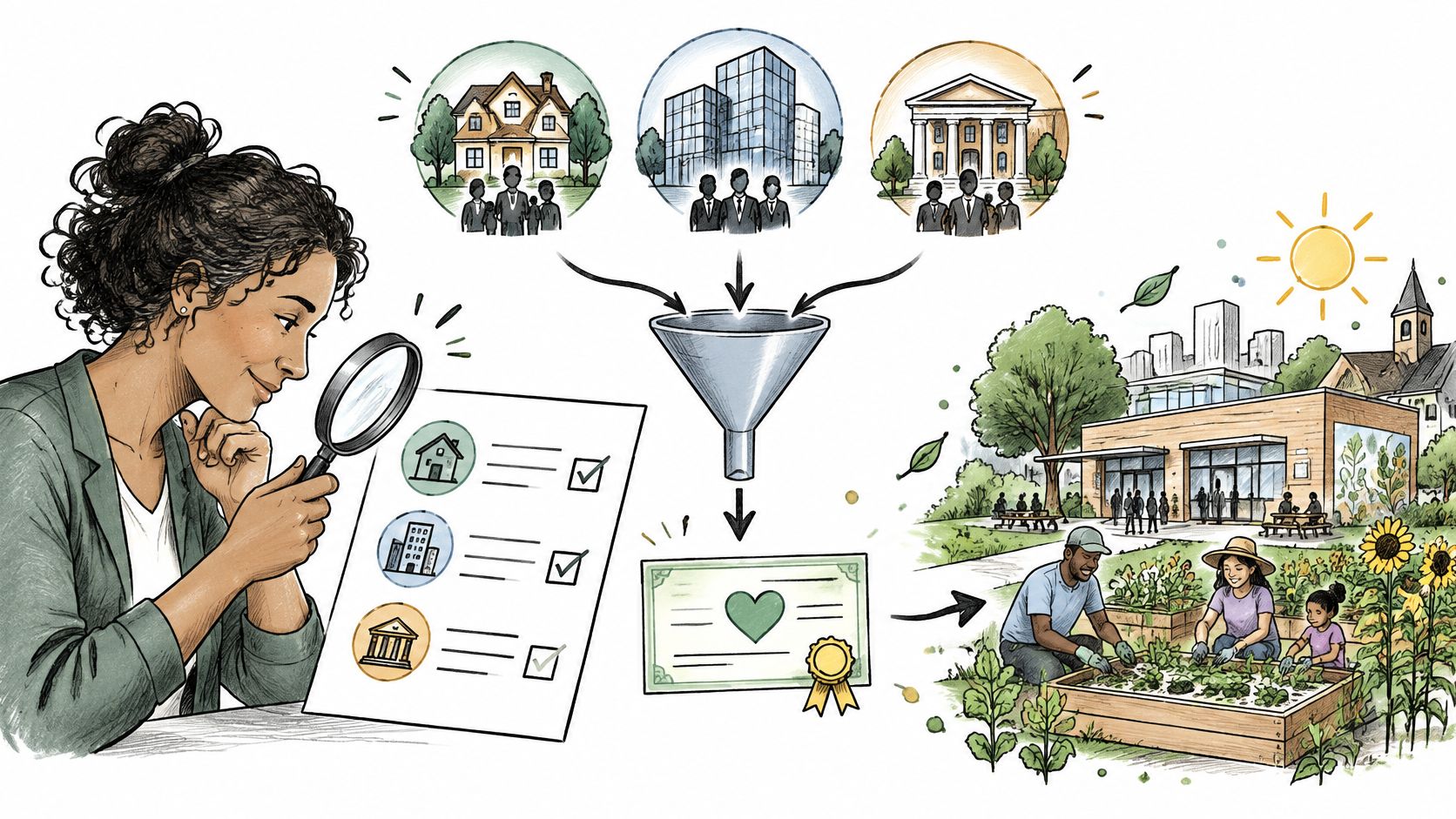
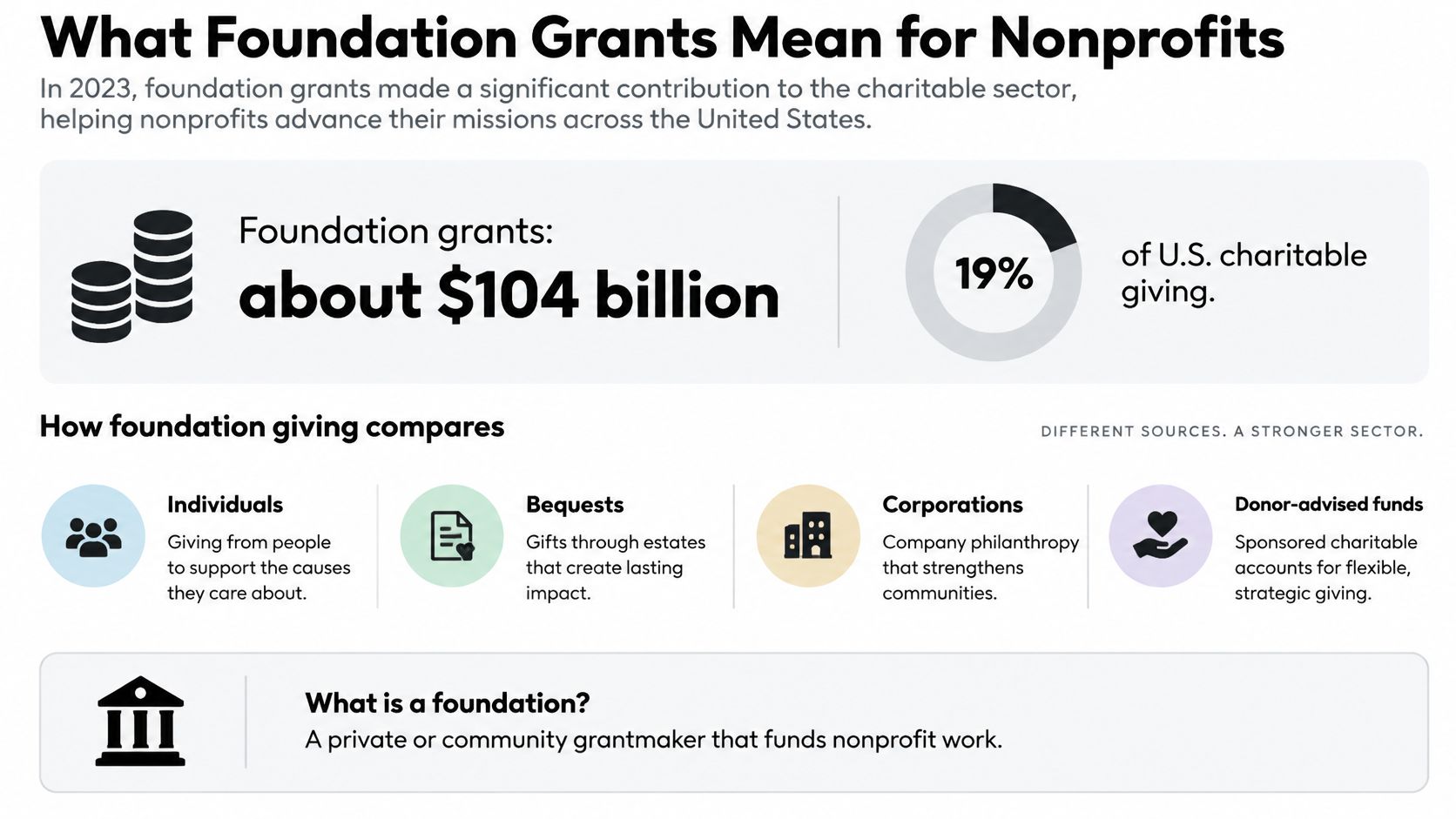
Foundation grants accounted for approximately $104 billion, or 19% of total U.S. charitable giving, in 2023, according to Candid. For a small nonprofit, that's a substantial funding opportunity. But the useful question isn't how much foundation money exists. It's which funders you can realistically reach, and whether their awards will pay for the work you need to do.
Table of Contents
- What Foundation Grants Mean for Nonprofits
- Private Family Corporate and Community Foundations Compared
- Restrictions That Decide Eligibility Before You Write
- Rank Reachable Funders and Build Your First Shortlist
- When a Smaller Unrestricted Grant Beats a Bigger Award
- Application and Stewardship Practices That Protect the Award
What Foundation Grants Mean for Nonprofits
A foundation grant is an institutional award from a grantmaking foundation for a charitable purpose. The award usually comes with an approved purpose, a budget, and expectations about reporting. It isn't necessarily unrestricted money, and it isn't payment for anything your organization chooses to deliver.
Think of an individual donor as a person choosing a cause. A foundation is more like a rules-bound checking account with a board, distribution obligations, and limits on what it can support. The people managing that account must make decisions within those boundaries.
The scale is worth understanding before you start prospecting.
A grant is a funding agreement, not a blank check
Say your community organization runs an after-school program. A foundation might support tutoring, but exclude transportation, fundraising, or purchases outside the approved project period. Your program can fit its charitable purpose while parts of your budget remain ineligible.
That distinction matters for ordinary purchases, too. If your outreach budget includes staff clothing, a resource such as Dirt Cheap Product, Inc.’s guide to embroidered apparel for nonprofit staff can help you plan the purchase. Whether grant funds can pay for it is a separate question, answered by the award terms.
Before treating an award as available revenue, establish:
- Purpose: What activities can the money support?
- Period: When can you incur eligible expenses?
- Accountability: What spending records and results must you provide?
- Flexibility: Can you move money between budget categories?
Small teams need selective prospecting
Foundation grants for nonprofits sit alongside individual donations, estate gifts, corporate philanthropy, and donor-advised giving. They can diversify your revenue, but they also require research and administrative capacity.
Don't assume a large funding market makes access straightforward. Geography, applicant category, operating budget, issue area, and invitation status can each eliminate an otherwise promising match.
Practical rule: A promising foundation is one whose rules, access route, and award terms fit your organization, not simply one whose mission resembles yours.
Assign someone to maintain a prospect record rather than asking everyone to collect names independently. Give that person your legal status, service area, program priorities, and funding needs.
The result should be a manageable set of funding decisions. You're not trying to enter every competition. You're trying to identify institutional partners whose support your team can obtain, use responsibly, and administer without weakening the work.
Private Family Corporate and Community Foundations Compared
Foundation types nonprofits prospect
| Type | Who controls giving | Recent giving pattern | Typical access | Check first |
|---|---|---|---|---|
| Independent private foundation | Endowed organization and its board | Check whether its own giving is stable, expanding, or contracting | Prior grantees or an application route specified by the foundation | Formal limits on geography, field, recipient type, and dollars |
| Family foundation | Private foundation steered by family trustees | Use that family's year-to-year history, not a sector average | Hometown interests, personal causes, and trustee relationships may matter | New-grantee history and any unsolicited-application prohibition |
| Corporate foundation | Company-funded grantmaker, separate from sponsorships | Review the foundation's grant history separately from company marketing | Business footprint, employees, and company priorities can shape access | Operating locations versus your service area |
| Community foundation | Place-based public charity pooling local donors and funds | Examine the specific competitive fund, not just institution-wide totals | Local competitive programs, each with its own selection rules | County or metropolitan limits and fund-level eligibility |
These categories describe who controls the money, not how easy it will be to receive it. A family foundation is usually a private foundation for tax purposes, rather than a separate IRS category. Community foundations, by contrast, are public charities that may administer different funds with different decision-makers.
According to Candid's survey of 496 foundations, median community-foundation giving rose 6.6% in 2023, median corporate-foundation giving increased 1%, and median independent-foundation giving was unchanged. Those medians describe the surveyed groups, not what a particular prospect will do.
Read the decision structure
An independent foundation may have professional program staff, detailed guidelines, and a formal review calendar. Start with the published program, then inspect whether its recent recipients resemble your organization in geography, activity, and organizational scale.
At a family foundation, trustees may make decisions directly. Hometown commitments and personal interests can explain giving that a broad mission statement doesn't. Treat those as research questions, not permission to invent a personal connection or approach trustees through private channels.
A corporate foundation also needs careful classification. A charitable grant, event sponsorship, and employee matching gift can come from different budgets and require different applications. Don't send a sponsorship benefits package when the foundation asks for a charitable project proposal.
Community foundations deserve fund-level research. Their institution-wide grant totals can include donor-advised distributions that aren't available through an open application. The Council on Foundations' CF Insights results show that community foundations in its sample awarded $14.865 billion in fiscal year 2024, but that total isn't a competitive-grant pool.
Don't turn payout rules into an award forecast
Under the IRS instructions for Form 990-PF, a domestic private foundation generally calculates a minimum investment return using 5% of the fair market value of noncharitable-use assets, subject to adjustments, and must make qualifying distributions of its distributable amount by the end of the following tax year.
That isn't a promise that the same share of assets will become grants available to new applicants. Qualifying distributions include permitted uses beyond awards to organizations like yours.
Research the funder's actual grants and application route. Asset size alone doesn't tell you whether there's an accessible opportunity.
For a small team, the best starting category is the one with an identifiable route in: a relevant competitive community fund, an independent foundation accepting inquiries, or a corporate program serving your locality. Familiarity with a foundation's name isn't a reason to prioritize it.
Restrictions That Decide Eligibility Before You Write
Say an Ohio youth organization finds a foundation whose mission mentions opportunities for young people. That sounds encouraging until the formal guidelines limit grants to California universities.
The mission overlaps. The applicant doesn't qualify.
Every private foundation generally files a publicly disclosable annual Form 990-PF, and Part XV provides information about grant programs and restrictions involving geography, charitable field, recipient type, dollar limits, and other award conditions, according to the IRS guidance on private foundations. Use those restrictions as a pass-fail screen, not as background reading after you've drafted an application.
Pass-fail screen before any letter of inquiry
| Check | Ohio youth program example | Result |
|---|---|---|
| Geography | Foundation funds only California | Stop |
| Recipient type | Foundation funds only universities | Stop |
| Dollar range | The proposed request exceeds the foundation's published maximum | Stop unless the request fits the range |
| Open status | Explicit unsolicited-application prohibition or invitation-only policy | Stop unless invited |
| Recency | Latest Form 990-PF tax period and filing date | Recheck when the next return posts |
Separate purpose, restrictions, and access
Foundation descriptions often contain different kinds of information that shouldn't be merged.
- Narrative purpose: Broad language about the change the foundation wants to support.
- Formal restrictions: Conditions defining which organizations, activities, places, and requests qualify.
- Application policy: Instructions explaining whether and how an eligible organization may approach the funder.
A foundation can support youth development, accept your applicant category, and still decline unsolicited proposals. Conversely, an open application doesn't cancel a geographic restriction.
Don't reduce your request merely to get under a maximum if the smaller award would leave an unfunded project your organization can't deliver. Eligibility should identify a workable opportunity, not encourage you to disguise the actual cost.
Record the evidence, including its age
A tax return documents a reporting period. It isn't a live request for proposals, and a historical grant doesn't establish that the same program is accepting applications today.
Save the tax period, filing date, recipient list, program description, and stated limitations in your prospect record. Keep the source document alongside your interpretation so another team member can verify why you marked the foundation eligible.
When the current website and an older filing disagree, seek clarification through the foundation's published contact route. Don't choose whichever version makes your organization eligible.
Before drafting a letter of inquiry, your record should show an applicant-category match, a service-area match, an appropriate request amount, and a confirmed application route. Mark uncertain fields as unresolved rather than passing them by default.
An unanswered eligibility question is a research task. It isn't a reason to start writing and hope the proposal persuades someone to make an exception.
Rank Reachable Funders and Build Your First Shortlist
A long list of mission matches is a research dump, not a pipeline. Reachable access means you can explain how an organization like yours could realistically enter the funder's decision process.
Administrative barriers deserve attention. Among organizations that had never applied for government funding, the 2025 Nonprofit Finance Fund survey found that 44% cited an onerous application process and 41% cited not knowing about relevant opportunities. Those are government-funding findings, not foundation-specific rates, but they illustrate why discovering an opportunity and being able to pursue it are different problems.
Use the process below to turn discovery into a selective outreach plan.
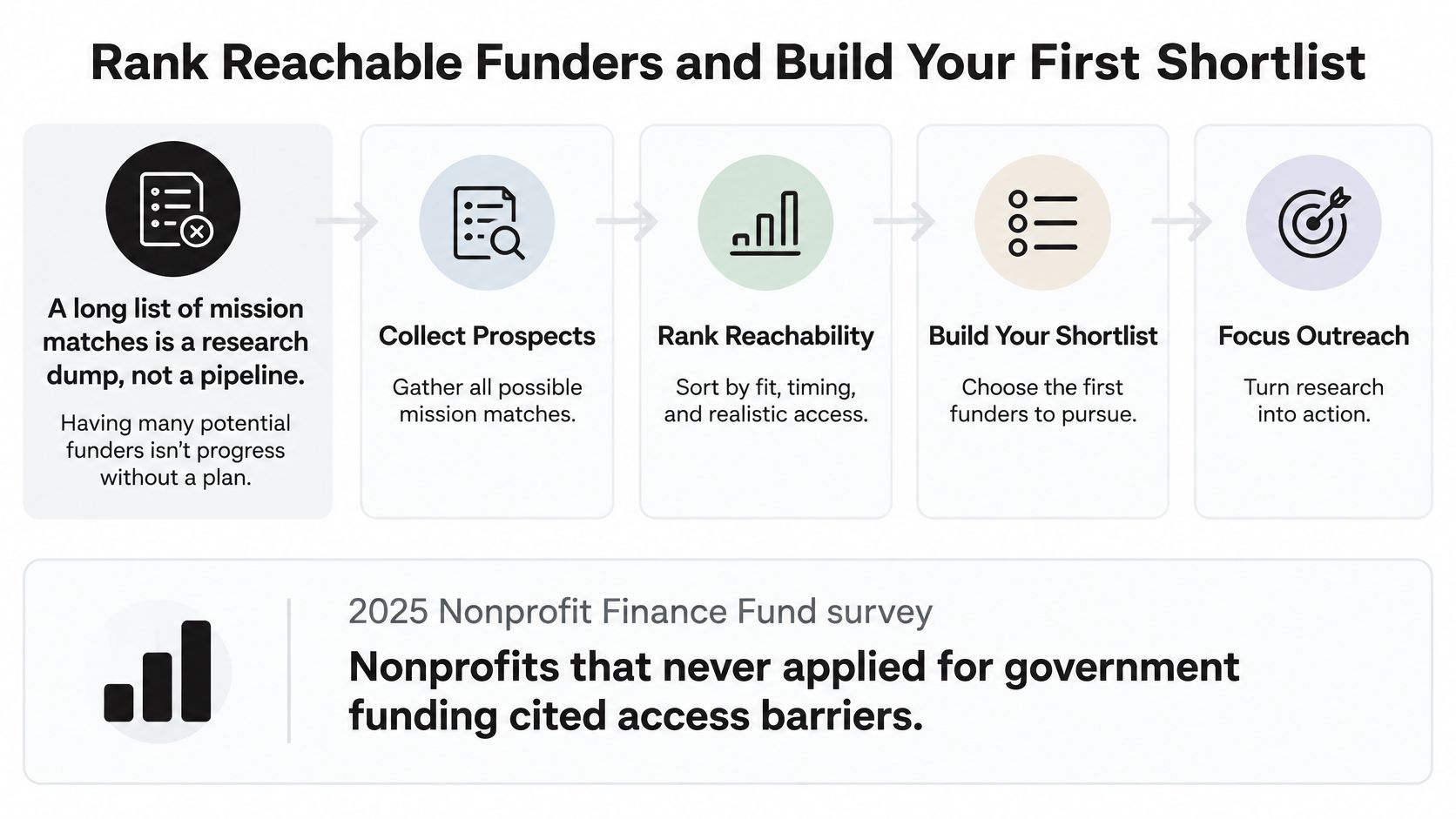
Build the list around evidence of access
Lock your organization profile. Record legal status, service geography, operating budget, issue area, and the smallest and largest award your team could use well. Distinguish current programs from ideas you'd only launch if funded.
Find candidates through comparable organizations. Inspect recipient lists for nonprofits serving similar communities with similar activities. Include local community-foundation funds, but investigate each program separately. A peer's grant is a lead, not proof that you qualify.
Remove hard mismatches. Close records that fail your eligibility screen. Keep an invitation-only foundation outside the active application queue unless you have a legitimate invitation route.
Read restrictions separately from mission language. Copy the operative requirements into your record. Don't let an attractive mission summary override a condition your team can't meet.
Assess access using observable signals. Look for awards to new grantees, published inquiry procedures, relevant trustee connections you have, and opportunities to request feedback. A recipient list dominated by returning organizations calls for caution, not an automatic assumption that outsiders are excluded.
Keep a short, ordered working list. Aim for about ten prospects as a planning target. Rank credible access and usable support ahead of assets or name recognition. Give every prospect a named owner and a next action.
Maintain the evidence. Store the filing year and the date you checked current guidelines. Update the record when a new return or program notice appears, rather than leaving an old conclusion untouched.
A simple access label works better than false mathematical precision: open and evidenced, eligible but uncertain, or relationship-dependent. Add a short explanation so colleagues can challenge the classification.
Make a first pass within a working week
Use an initial week as a time-box, not a promise of an award. Establish the profile first, collect a manageable candidate list next, and reserve separate time for eligibility checks and prioritization.
Only draft an inquiry when the leading prospect has a clear route in. If none qualifies, the week still produced something useful: evidence that you need different prospects rather than better prose.
For a visual companion to the outreach process, use the following video.
At Grantlas, we read your website or EIN, build your profile, and match foundations and federal, state, and local grants to it. Our matching includes fit assessments, invitation-only red flags before you write, and peer prospecting to identify funders supporting organizations like yours.
Use our guide to foundation research tools to decide which research tasks to automate. Confirm the funder's current guidelines before sending anything, regardless of how you found the opportunity.
When a Smaller Unrestricted Grant Beats a Bigger Award
A $75,000 restricted grant can leave a nonprofit with less usable support than a smaller general-operating grant. Suppose the larger award excludes indirect expenses and requires project-specific reporting, while the smaller one can pay for staff and systems that keep existing services running. The right comparison is what each award will cover and what obligations it adds.
Compare usable support, not headline dollars
Build a full-cost budget before evaluating an offer. Include direct delivery expenses, supervision, finance administration, technology, facilities, and staff time for documenting the work. Then identify which costs the award covers and where the rest of the money will come from. An excluded expense still has to be paid.
What to compare before accepting a foundation award
| Test | Benchmark | How to use it |
|---|---|---|
| Unrestricted share | Your actual flexible revenue versus committed expenses | Check recipient history before treating a general-operating statement as evidence of flexible awards |
| Grant size versus full cost | Award amount against direct and indirect delivery costs | Identify the unfunded balance before accepting |
| Cash timing | Confirmed decision and payment schedule | Compare payment dates with payroll and supplier obligations |
| Staff burden | Estimated application, administration, and reporting hours | Consider whether the workload is proportionate to the usable support |
| Renewal odds | Written multiyear commitment or documented renewal process | Don't base ongoing costs on hoped-for renewals |
| New-applicant reality | Evidence of support for organizations new to the funder | Check whether new applicants actually receive awards |
Treat matching requirements as a separate commitment. Name the source of the match, confirm it qualifies, and decide what happens if fundraising falls short.
A $20,000 award may be more useful than $75,000 if the smaller grant covers existing costs and the larger one requires your team to subsidize a new project. Conversely, a restricted award can make sense when it fully funds work your organization already plans to deliver.
Distinguish committed support from hoped-for renewal
A renewable grant is not a multiyear commitment. Unless the agreement promises future support, don't use anticipated renewals to justify permanent costs your organization could not otherwise sustain.
Among nonprofit respondents reporting grant activity in 2023, GrantStation's 2024 report found median total grant funding of $170,000 and a median largest individual award of $75,000. These respondent-level figures are context, not a forecast of what a particular foundation will offer.
Before prioritizing flexible support, check whether the funder gives general-operating grants to new applicants or mainly to established partners. Recipient descriptions and award purposes can help distinguish a reachable opportunity from a broad statement of intent. For more on the difference, see this guide to unrestricted grants for nonprofits. A strong prospect is one your organization can access, with terms, amount, and timing that support the actual cost of the work.
Application and Stewardship Practices That Protect the Award
An application demonstrates that you can carry out work the guidelines already permit. It isn't a vehicle for arguing past a restriction.
Follow the requested format, lead with the eligible activity, and attach a budget that matches your narrative. If the funder requests a letter of inquiry, send that rather than an unsolicited full proposal.
Prepare the application and administration documents together so your delivery team inherits a workable agreement.
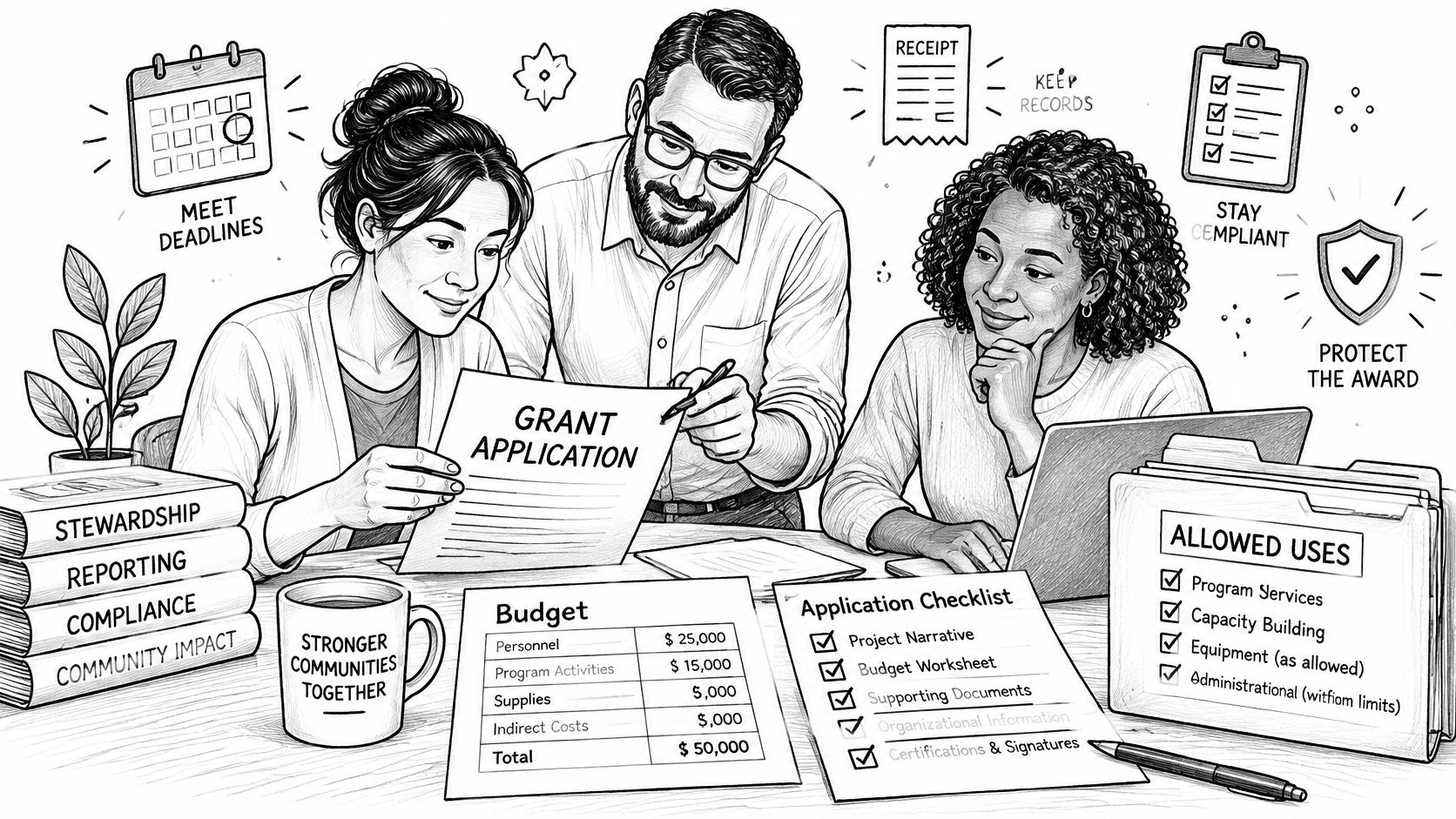
Assign responsibility before submitting
Name the program lead, finance owner, and person responsible for reporting. Agree on what you can measure using records your team can maintain, rather than promising outcomes you have no practical way to verify.
Use a proposal checklist to catch avoidable mistakes:
- Customized narrative: Explain the specific activity instead of recycling a generic mission paragraph.
- Reconciled budget: Make sure totals and funding sources agree across attachments.
- Achievable commitments: Confirm staffing, partner roles, and any required match.
- Submission control: Save the submitted version, confirmation, and correspondence.
Use how to write a grant proposal when translating that preparation into the requested document. Clear evidence matters more than ambitious language.
Make reporting part of delivery
After an award, track restricted funds separately in your accounting records. A separate bank account isn't automatically necessary; use the agreement and your accounting advice to determine the appropriate controls.
Calendar reports before delivery starts. Keep invoices, expenditure records, output logs, and explanations of material changes together so reporting doesn't become a reconstruction exercise.
Before changing the work: Request written approval when the agreement requires it. Don't wait until the final report to disclose a different project.
For cross-border funding or fiscal-sponsor arrangements, clarify documentation and reporting responsibilities before applying. Have legal-status records, the approved budget, spending controls, and any relevant agreements ready for review.
Keep the funder informed without overwhelming staff with unnecessary updates. For reliable correspondence, Listava's guidance to improve nonprofit email deliverability can support contact-list hygiene, but confirm receipt of critical submissions through the funder's designated channel.
Close with a report that connects spending to approved activities and candidly explains results. Good stewardship can support a renewal conversation, but it doesn't guarantee another award.
Grantlas helps you identify prospective funders, evaluate their fit, and spot access barriers before investing in an application. Visit Grantlas to build a profile from your website or EIN and start a shortlist of foundation prospects whose requirements match your organization's work.