How to Find Foundation Grants: A Practical Search Guide


92% of surveyed organizations applied for private foundation funding in 2023, according to GrantStation's 2024 State of Grantseeking findings. Finding foundations isn't the unusual part. Deciding which ones deserve your team's limited proposal-writing time is the harder job.
Learning how to find foundation grants means answering more than whether a funder supports your cause. You need evidence that it funds organizations like yours, offers a realistic application route, and provides support you can use. A focused shortlist of reachable funders is more useful than a directory export full of recognizable names.
Table of Contents
- Where Foundation Grants Are Published
- Search by Geography, Sector and Grant Size
- Read 990-PF Filings for Real Giving Patterns
- Check Whether a Funder Is Reachable
- Prioritize Funders That Renew and Give Flexible Support
- Set Up Alerts and a Monthly Review Routine
- Confirm Your Shortlist and Contact the First Funders
Where Foundation Grants Are Published
Private-foundation research starts with public records, not search-engine results. The IRS private-foundation study explains that private foundations file Form 990-PF, an annual return reporting charitable distributions, expenses, income, and balance-sheet information, and provides statistics and microdata for tax years 1985 through 2022.
For prospecting, focus on nonoperating foundations. These generally support charitable organizations through grants and other financial assistance, rather than primarily conducting their own charitable programs.
Match the source to the funding question
Search a foundation's legal name in IRS Tax Exempt Organization Search or ProPublica Nonprofit Explorer, then open its latest available filing and attachments. A foundation website explains how it presents its priorities today; the filing lets you examine its financial activity and grantmaking history.
Where to search and what each source covers
| Source | Where it is published | Best used for |
|---|---|---|
| Private foundations | IRS Form 990-PF filings | Recent grant schedules, recipients and stated restrictions |
| Community foundations | Their own websites and grant reports | Local giving and donor-advised fund activity |
| Federal grants | Grants.gov | Open federal opportunities with posted deadlines |
| State and local grants | State grant portals, for example California and Illinois | Region-specific government funding |
| Arts and humanities | State arts agencies and humanities councils | Arts, culture and humanities projects |
These sources answer different questions. A government portal identifies a published opportunity; a foundation filing documents historical activity. Neither automatically tells you whether your organization should apply.
Community foundations also require careful reading. Donor-advised funds accounted for 67% of grant dollars reported by community foundations in fiscal year 2024, according to the Council on Foundations' CF Insights results. Don't assume every grant in a community foundation's report came through an open competitive program.
Use directories to locate evidence
A directory can help you identify names, compare records, and reach the underlying documents. Our Foundation Directory Online guide provides context for choosing a research starting point.
At Grantlas, we have 137,257 funders on file, covering private foundations and grantmaking charities from IRS filings. Treat that breadth as a discovery resource, not a substitute for qualification.
Begin with foundation filings and local community-foundation reports. Add government portals when a published opportunity fits your applicant type and work, rather than broadening the search to produce more results.
Search by Geography, Sector and Grant Size
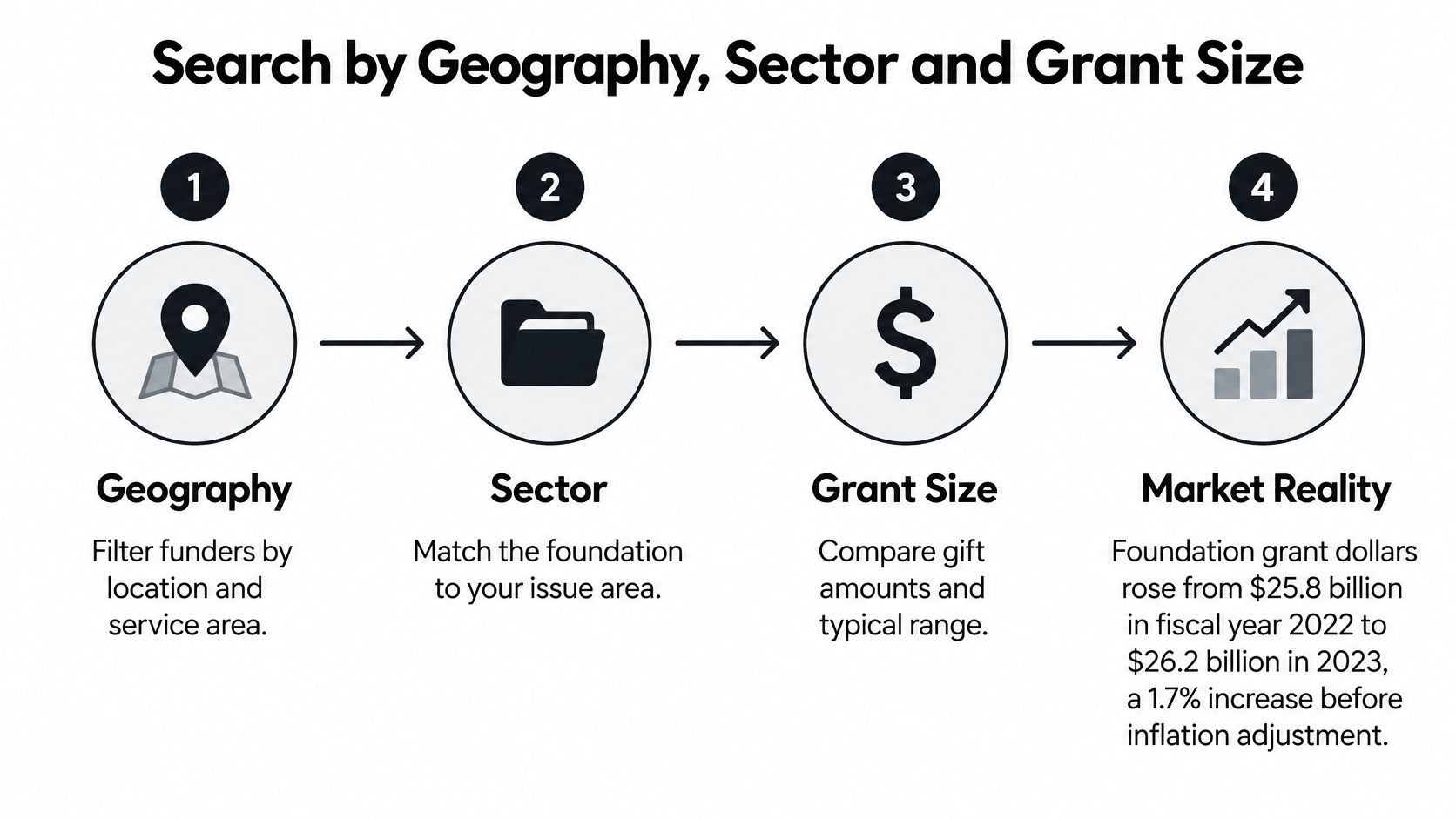
Funding growth doesn't mean every foundation has more money available. In a survey covering 496 foundations, cumulative grant dollars rose from $25.8 billion in fiscal year 2022 to $26.2 billion in 2023, a 1.7% increase before inflation adjustment, according to Candid's foundation-giving analysis.
Use this filtering sequence to turn a broad search into a workable prospect pool.
Apply hard filters before exploring possibilities
Define the service geography. Write down where beneficiaries receive services, not just your headquarters address. Search at the county, state, or multistate level, and distinguish local service delivery from work with a national scope.
Choose a specific sector. Translate your mission into fundable activities. A youth organization might search separately for after-school learning, housing stability, or behavioral health rather than rely on the broad word youth.
Set a defensible grant-size band. Start with the actual funding gap in an approved project or operating budget. Don't let a foundation's apparent wealth persuade you to invent a larger project.
Filter by applicant type. Identify whether the applicant is a public charity, school, government unit, or fiscally sponsored project. Resolve exclusions before assessing how compelling the program sounds.
Separate foundation types. Keep independent, corporate, and community-foundation prospects distinguishable. For community foundations, identify the particular competitive program rather than treating the institution's entire grantmaking portfolio as accessible.
Export and classify the results. Give each prospect a provisional status: shortlist, watch, or drop. Keep a reason beside the status so another staff member can understand the decision.
Search for the work, not just the mission
Say your organization provides transportation so rural residents can attend medical appointments. Search both the health purpose and the transportation activity. A foundation's directory category may describe the intended outcome while its grant descriptions reveal the practical service it supports.
Use peer organizations as search clues, too. Look for nonprofits serving similar populations with comparable delivery models, then inspect their publicly acknowledged supporters. A peer's funder is a lead to investigate, not evidence that you qualify.
Practical rule: Broaden terminology before broadening eligibility. Try another accurate description of your work before abandoning the geography or applicant requirements.
Keep the original search criteria beside the results. Otherwise, an appealing foundation name can gradually replace the budget, location, and program boundaries you started with.
Read 990-PF Filings for Real Giving Patterns
Open the grant schedule before studying the asset balance. The IRS instructions for Form 990-PF call for disclosure of restrictions involving geography, charitable field, recipient type, dollar amounts, and application requirements. Those are useful qualification fields, not administrative details to skim past.
Give yourself an uninterrupted document-review session for each serious prospect.
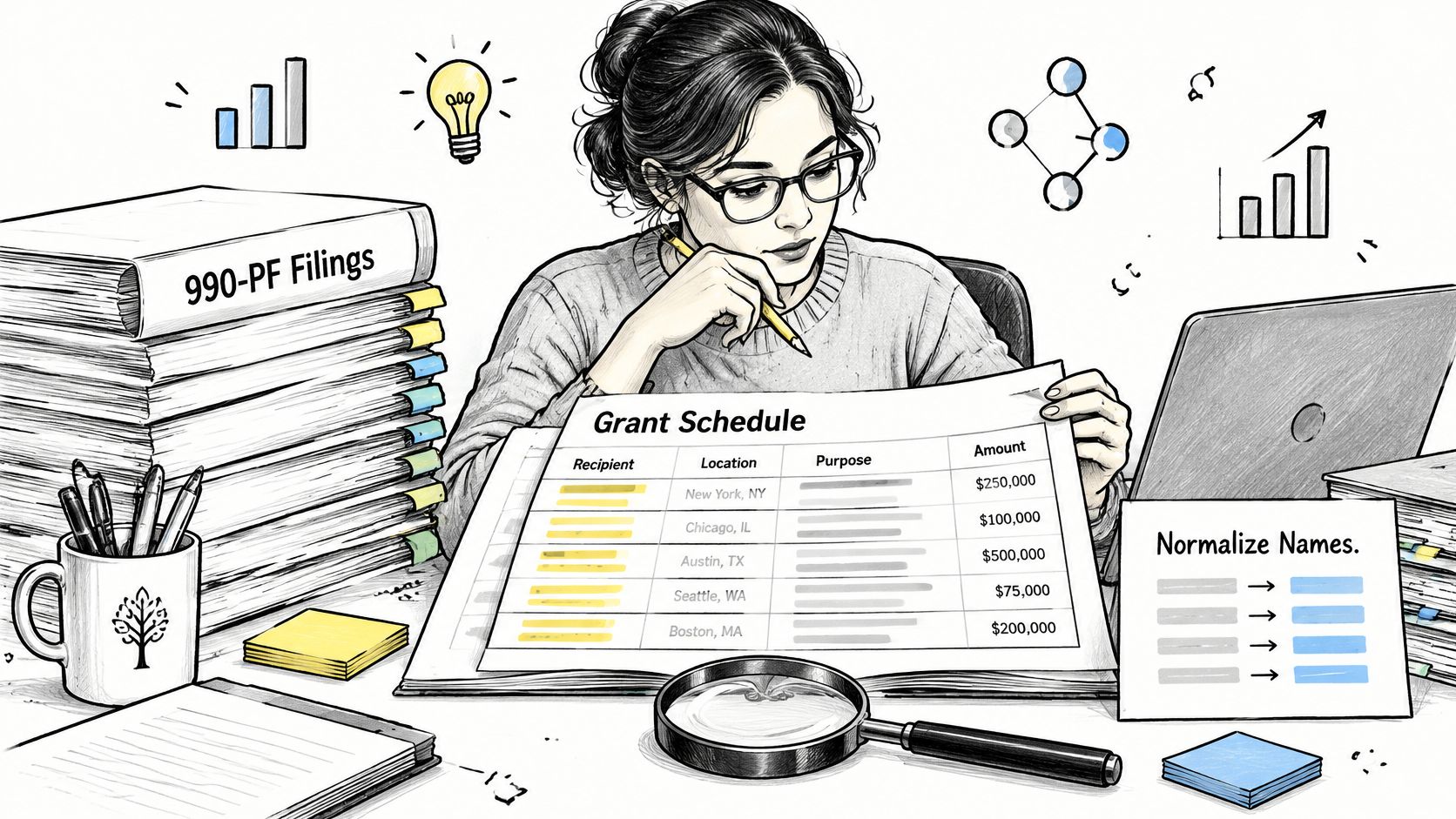
Turn the schedule into comparable evidence
Create a spreadsheet with recipient name, recipient location, grant purpose, amount, and filing year. Normalize abbreviations and name changes so you don't mistake an established grantee for a new organization.
Then calculate practical benchmarks:
- Median comparable award. Use grants supporting similar work, not an indiscriminate mix of scholarships, institutional gifts, and small community awards.
- Interquartile range. Identify the middle portion of awards to understand the ordinary range without allowing exceptional gifts to dominate.
- Geographic share. Decide whether you're measuring the share of grant count or grant dollars, and label it consistently.
- Apparent new recipients. Compare names across available filing years, recognizing that a recipient absent from those records may have received earlier support.
Don't combine grants paid with grants approved for future payment. Keep the categories distinguishable so your calculations answer a clear question.
Test the request against a hypothetical schedule
Suppose a foundation's comparable grants have a hypothetical median of $12,000 and an interquartile range of $8,000 to $25,000. A hypothetical $15,000 request would sit inside that range, above the median but within ordinary practice.
A hypothetical $60,000 request would sit well beyond the upper quartile. That doesn't prove rejection, but it calls for stronger evidence, a smaller funding request, or a separable project phase.
Don't shrink a necessary project into an unworkable budget just to match a funder. If the ordinary award can't support a useful piece of the work, the prospect may not belong on your active list.
Use the video alongside the source document, keeping your own extraction sheet open.
Assets describe financial scale. Comparable grants provide a more useful basis for a request.
Finish each review with the filing year, document reference, and a confidence note. A detailed but old schedule shouldn't carry the same weight as current, corroborated evidence, and historical giving alone doesn't establish today's application route.
Check Whether a Funder Is Reachable
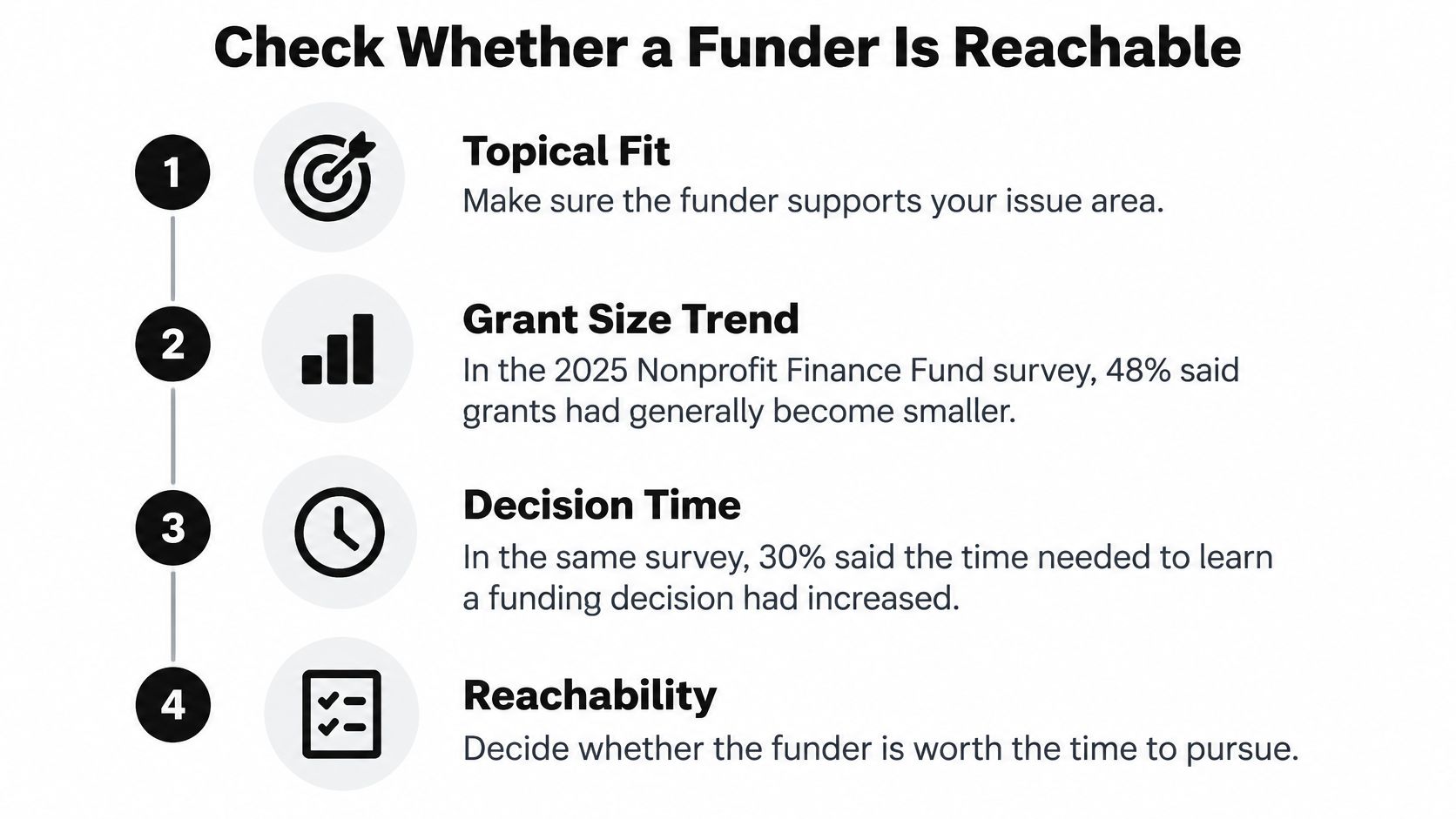
In the 2025 Nonprofit Finance Fund survey, 48% of respondents said grants had generally become smaller, and 30% said the time needed to learn a funding decision had increased. Your team needs to assess the cost of pursuing an opportunity, not just its relevance.
A foundation can be a strong topical match and a poor immediate prospect. Invitation-only procedures, unclear timing, or no apparent entry route can make an otherwise attractive funder impractical.
Compare fit and access separately
Fit and access signals to check before applying
| Signal | Where to find it | Green light | Red flag |
|---|---|---|---|
| Accepts unsolicited requests | Funder website and application guidelines | Open process stated plainly | Invitation only or no guidelines |
| Geographic match | Recent grant schedule in the 990-PF | Recent grants in your county or state | No recent grants in your region |
| Typical award size | Median and upper quartile of comparable grants | Your request sits inside the interquartile range | Your request is well above the upper quartile |
| New grantee activity | Recipient lists across several filing years | First-time recipients appear regularly | The same recipients appear every year |
| Recency of data | Filing year on the record | Latest filing is recent | Latest filing is several years old |
A red flag isn't always proof of ineligibility. Missing guidelines mean access is unconfirmed; repeated recipients suggest caution but don't prove a closed process.
Use a practical screening rule:
- Green for active pursuit. The application route is confirmed, eligibility is satisfied, and most evidence supports a realistic request.
- Yellow for clarification. A material question remains about access, timing, award size, or current priorities.
- Red for the active pipeline. An explicit restriction excludes you, the process is invitation only without an invitation, or the geographic evidence contradicts your fit.
Include the work after submission
Ask what the application requires, when decisions are expected, and whether reporting fits your staff capacity. A modest award with a heavy custom evaluation requirement may be less useful than a comparable award with proportionate reporting.
If your community relationships need clearer presentation, MD TECH TEAM's nonprofit community engagement ideas can help you plan how to communicate participation and partnerships. That work strengthens your explanation of local credibility; it doesn't override eligibility.
Keep the ranking rationale brief: open inquiry route, comparable program awards, new recipients visible, decision timing workable. Rank the opportunity you can responsibly pursue, not the institution you'd most like to name in an annual report.
Prioritize Funders That Renew and Give Flexible Support
The largest available grant isn't necessarily the most valuable grant. In the Nonprofit Finance Fund's 2025 survey report, 64% of nonprofits reported that less than half of their 2024 grants and donations were unrestricted. Restricted funding can finance worthwhile work while leaving the organization struggling to cover the infrastructure that makes it possible.
Treat renewal potential, flexibility, and duration as distinct prospecting questions. An award can be flexible but short-lived, or multiyear but tightly restricted.
Read for durability, not just repetition
Repeated awards deserve investigation, but they aren't a promise of renewal. Compare recipient names, purpose descriptions, payment schedules, and any published renewal conditions.
- Check continuity. Does the foundation support the same organization across filings, or does an apparent repeat reflect installments of an existing commitment?
- Identify permitted uses. Look for general operating support, project-specific language, or a named capital purpose. Don't infer unrestricted support from a vague description.
- Establish duration. Confirm whether the award covers a grant period, a renewable arrangement, or a documented multiyear commitment.
For a hypothetical small nonprofit, a $15,000 general-support grant renewed across three years might provide more dependable operating support than a single $80,000 restricted project grant. The larger award may still be preferable if it fully funds essential work and includes its real delivery costs.
Test usefulness with the finance team
Before prioritizing restricted funding, ask your finance lead how the award would be tracked and whether its terms leave necessary costs uncovered. For practical accounting context, Bookkeeping and Accounting of Florida explains grants and their management implications.
Use our guide to unrestricted grants for nonprofits to sharpen the search for flexible support. Keep the prospecting distinction clear: a funder that has renewed others offers evidence worth examining, not guaranteed future revenue.
Decision test: Would this grant strengthen the organization, or require a new fundraising effort just to deliver what it funds?
Set Up Alerts and a Monthly Review Routine
A prospect list becomes unreliable when nobody owns its maintenance. Assign a staff member to monitor changes and another person to cover absences, rather than leaving alerts in an unattended shared inbox.
Keep the routine narrow enough to complete consistently. You don't need to reread every filing whenever a notification arrives.
Configure monitoring around decisions
Save separate searches. Keep distinct searches for different programs or service areas. Clear names make it easier to identify why a new result belongs in the pipeline.
Route alerts into a review queue. Use a weekly digest where available, and send relevant funder newsletters to the same folder. Separate discoveries from prospects already approved for pursuit.
Create internal deadlines. Work backward from the submission date to budget approval, partner materials, leadership review, and submission testing. Build in time for missing documents rather than setting only a final reminder.
Assign the next action. Every active prospect needs an owner and an action, such as confirm applicant eligibility or prepare an inquiry. A status without an action isn't a work plan.
Reassess rather than accumulate
During the monthly review, compare changed guidelines and newly available records with the reason you originally shortlisted the funder. Move uncertain prospects to watch instead of letting them compete with ready opportunities.
Use a compact decision log:
| Field | What to record |
|---|---|
| Review date | When someone checked the evidence |
| Material change | New guidelines, filing, contact, or decision |
| Status | Pursue, watch, drop, or awaiting response |
| Next action | Named owner and scheduled task |
Archive rejected prospects with their exclusion reason intact. Otherwise, a colleague may rediscover the same foundation and repeat the same research.
End the review with an outreach calendar, not a larger spreadsheet. The useful output is a current set of decisions your team can act on.
Confirm Your Shortlist and Contact the First Funders
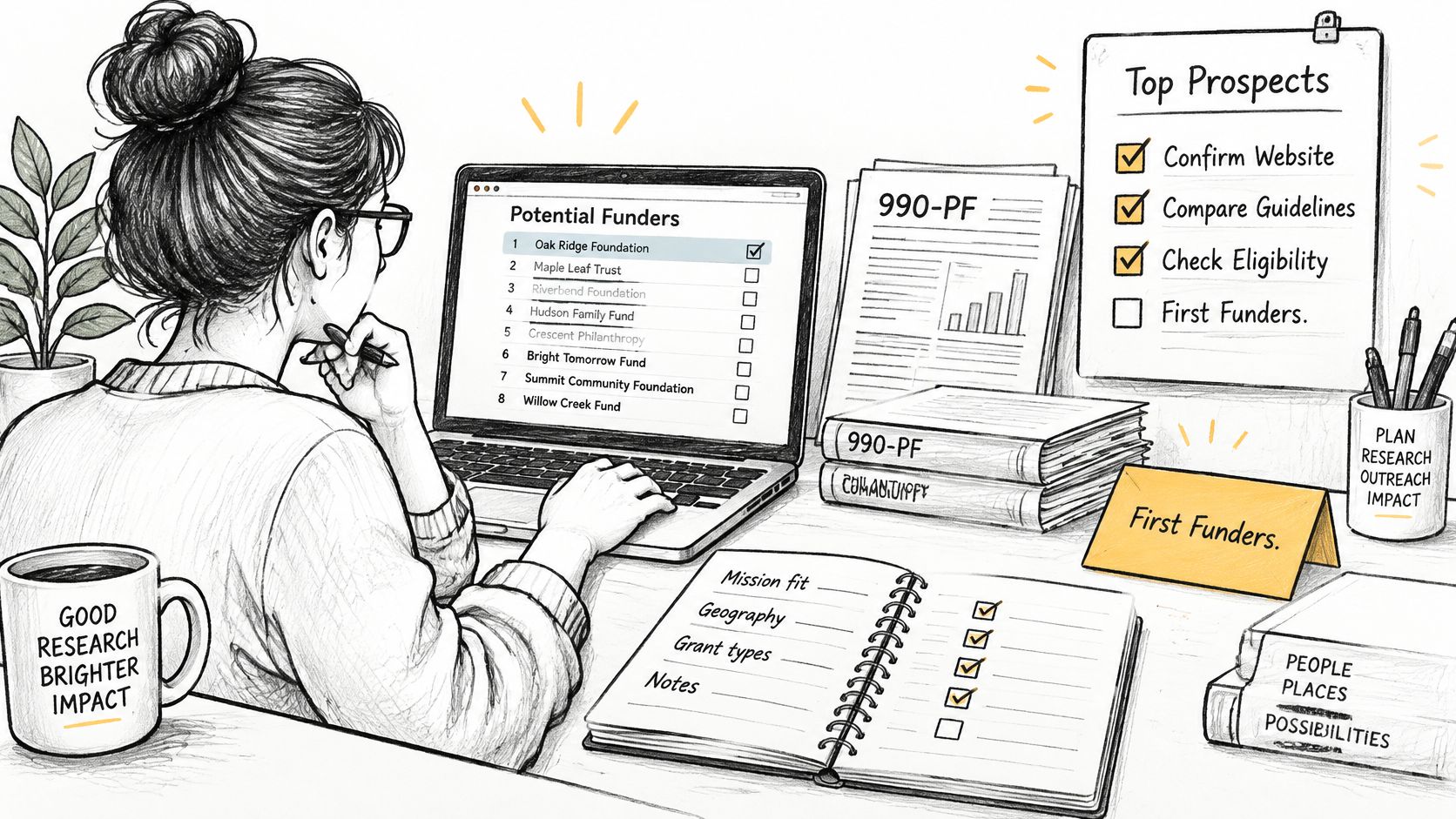
Outreach should resolve a decision, not introduce your organization indiscriminately. Start with the strongest prospects and identify what you need to learn before committing to a full proposal.
Keep the funder's current instructions beside your notes as you prepare contact.
Make the inquiry easy to assess
Confirm the current opportunity. Check the official website for the relevant program, current guidelines, and permitted contact method. Resolve conflicts between directory information and current instructions before submitting anything.
Perform a final eligibility check. Confirm the actual applicant, service area, requested purpose, and budget. If a fiscal sponsor or partner will apply, assess that arrangement explicitly.
Follow the stated entry route. Submit an inquiry if requested; use the application portal if direct applications are required. Don't send an unsolicited attachment when the funder prohibits one.
Ask a focused question when contact is welcome. Explain the work briefly and ask about the unresolved issue, such as whether your delivery model fits the program. Don't request a call merely to repeat information already published.
Prepare a concise inquiry. Name the program, intended beneficiaries, requested amount, expected result, and relevant evidence of alignment. Use these letter of inquiry examples to organize the message without turning it into a compressed full proposal.
Record the response and commitment. Capture invitations, exclusions, requested materials, and agreed follow-up dates. Update the prospect record so colleagues don't contact the same person independently.
Ask about timing without inventing urgency
When no deadline is published, ask whether inquiries are currently welcome and when decisions are considered. An absent deadline isn't evidence that applications are reviewed continuously.
If a program officer discourages the request, record the reason accurately. A timing problem may justify watching the next cycle; a fundamental eligibility mismatch usually justifies dropping the prospect.
Choose the strongest fit-and-access prospects this week, assign an outreach owner, and put their inquiries on the calendar. Send fewer, better-grounded messages rather than waiting until the entire database has been researched.
Grantlas builds an organization profile from your website or EIN and matches it with prospective funders and open grants, with fit reasoning and eligibility flags. Visit Grantlas to build your initial shortlist, then use giving history and current application guidance to choose the funders you'll contact first.