Foundation Prospect Research: A Practical Playbook


More than 1.7 million Form 990-PF filings sit behind the historical foundation-research infrastructure described in the IRS private-foundation statistics background. That's an extraordinary amount of public evidence. It's also a reminder that access to filings isn't the same as knowing which foundation deserves your next proposal.
Good foundation prospect research produces a decision, not a reading pile. A development team needs to know whether a funder is eligible, relevant, reachable, and worth scarce writing time. Just as much, the team needs to distinguish a genuine mismatch from a match it can't yet verify.
Table of Contents
- Why a Short Funder List Beats a Big One
- The Fit Scorecard for Every Prospect
- How to Read Filings and Tag Durable Signals
- Tools and Workflows That Scale the Routine
- Keep a Portfolio of 10 to 20 Prospects
- How to Sequence Outreach After the Score
- Finish Ten Scored Records This Week
Why a Short Funder List Beats a Big One
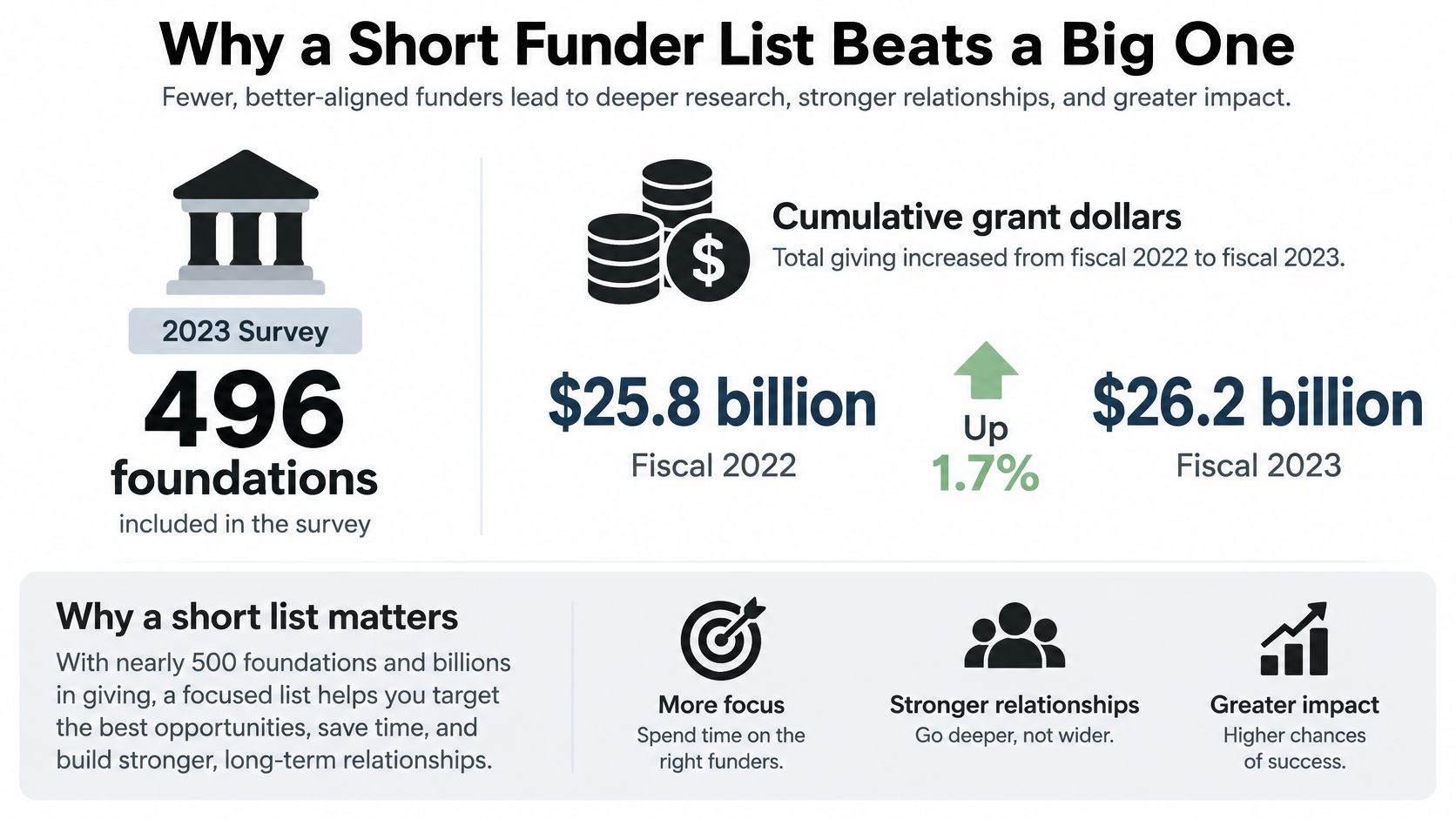
Foundation grant dollars increased just 1.7%, unadjusted, from $25.8 billion in fiscal 2022 to $26.2 billion in 2023, in a survey of 496 foundations, according to Candid's foundation-giving analysis. Those are substantial resources, but the aggregate doesn't tell a Colorado arts organization whether any particular foundation will consider its request.
The distinction matters. A foundation can have considerable assets and still be irrelevant to your program, closed to unsolicited requests, or committed to recipients outside your service area. Downloading its name doesn't create an opportunity.
The scale is easier to understand visually.
Research toward a decision
Foundation prospect research means building evidence that a funder fits your geography, program, request size, applicant eligibility, and submission path. The deliverable is a scored record that another staff member can understand and act on, not a directory export with promising names highlighted.
Start with the project you need funded. Identify who benefits, where the work happens, what the money supports, and what size award would make the project viable. Otherwise, researchers can stretch almost any broad mission statement into an apparent match.
A useful record answers practical questions:
- Eligibility: Can this organization apply for this activity?
- Demonstrated fit: Has the foundation funded comparable work?
- Financial fit: Does its ordinary award support a meaningful part of the request?
- Access: Is there a published application route or a credible introduction?
- Evidence quality: What supports the conclusion, and what remains uncertain?
Borrow the discipline, not the sales language
The same operational principle applies when teams build a decision-focused competitor intelligence pipeline, as described by Cyndra: collect information around a decision rather than collecting everything available. For grant teams, that decision is whether to investigate, contact, apply, or stop.
A manageable shortlist makes room for interpretation. Staff can read grant purposes, check current guidelines, and identify the right contact instead of repeatedly opening profiles they never finish.
Working rule: Mission statements and asset size provide context. Documented grants, filing year, and solicitation rules determine whether anyone starts writing.
Keep discovery broad enough to find unfamiliar funders, but keep active research narrow enough to finish. A recognizable foundation name shouldn't displace a less famous funder with a clear, usable application path.
The Fit Scorecard for Every Prospect
Run the gates before assigning points. A strong program match can disguise a disqualifying restriction, and staff end up debating a prospect they were never eligible to approach.
Applicant eligibility, service geography, solicitation status, and award range are pass-or-stop decisions. Unknown information means defer for verification, not assume a pass. An explicit failure removes the foundation from the current cycle.
Copy this foundation fit scorecard
The weights below are a suggested internal operating model, not a prediction of award probability. Use the same rules across your team so a high score means something consistent.
| Factor | What to record | How to score | Weight or action |
|---|---|---|---|
| Applicant eligibility | Whether your legal form and program type are allowed | Pass or fail; defer if unknown | Hard gate, stop if fail |
| Geography | Where grants support work, not the headquarters city | Pass or fail; verify service area | Hard gate, stop if fail |
| Solicitation status | Unsolicited LOI, invitation only, or no stated path | Pass, or defer until a relationship exists | Hard gate if invitation only and no tie |
| Award range | Typical, low, and high grant versus your ask | Pass if the ask sits inside the recent comparable range | Hard gate, stop if far outside |
| Program fit | Grants to your issue across recent filings | Suggested scale from 0 for none to 5 for repeated comparable grants | 30 percent |
| Grant size fit | Median recent comparable award versus your request | Suggested scale from 0 for poor alignment to 5 for ordinary award size | 25 percent |
| New grantees | Whether a recent award went to a first-time recipient | Suggested scale from 0 for no verified evidence to 5 for repeated evidence | 20 percent |
| Recency and direction | Filing year, trend, and signal classification | Suggested scale from 0 for unsupported to 5 for current, sustained evidence | 15 percent |
| Relationship path | Shared trustee, partner introduction, or permitted cold contact | Suggested scale from 0 for no route to 5 for a confirmed introduction | 10 percent |
Calculate the weighted total by dividing each factor score by its maximum, multiplying by its weight, and adding the results. Keep confidence separate from fit. A missing or stale filing lowers confidence in the score; it does not turn the prospect into a rejection. Record what the evidence cannot yet answer.
Before any outreach is planned, tag the signal behind a strong score: durable strategy, policy shift, or one-time response. A funder who granted once after a disaster reads differently than one who has funded your issue for years, even at the same score.
A hypothetical Colorado comparison
Say a youth-arts nonprofit with a $400,000 operating budget seeks $50,000. A hypothetical regional foundation's latest filing lists three comparable youth-arts grants ranging from $25,000 to $60,000, including a verified first-time recipient, and its website accepts unsolicited letters of inquiry.
Using this suggested model, the researcher might assign 4 for program fit, 5 for grant size, 4 for new grantees, and 4 for recency. A permitted cold-contact route might receive 2 for relationship access, producing a calculated 81 out of 100. These are example inputs, not findings about an actual foundation.
By contrast, a national health funder with inspiring language but no demonstrated arts giving receives no program-fit credit. Don't reinterpret its mission until the spreadsheet looks favorable.
Before scoring newly discovered grant funding opportunities, define the project and plausible ask. Then compare like with like: exclude exceptional capital awards when estimating ordinary program support.
- Save the evidence: Record the recipient, purpose, filing year, and supporting page.
- Explain the judgement: Add a short reason for each score rather than leaving an unexplained number.
- Separate uncertainty: Mark missing evidence explicitly instead of treating it as a documented rejection.
How to Read Filings and Tag Durable Signals
Read filings to answer specific questions, not from beginning to end. The financial summary helps establish scale; the grants schedule shows behavior; the current guidelines establish what you can do next.
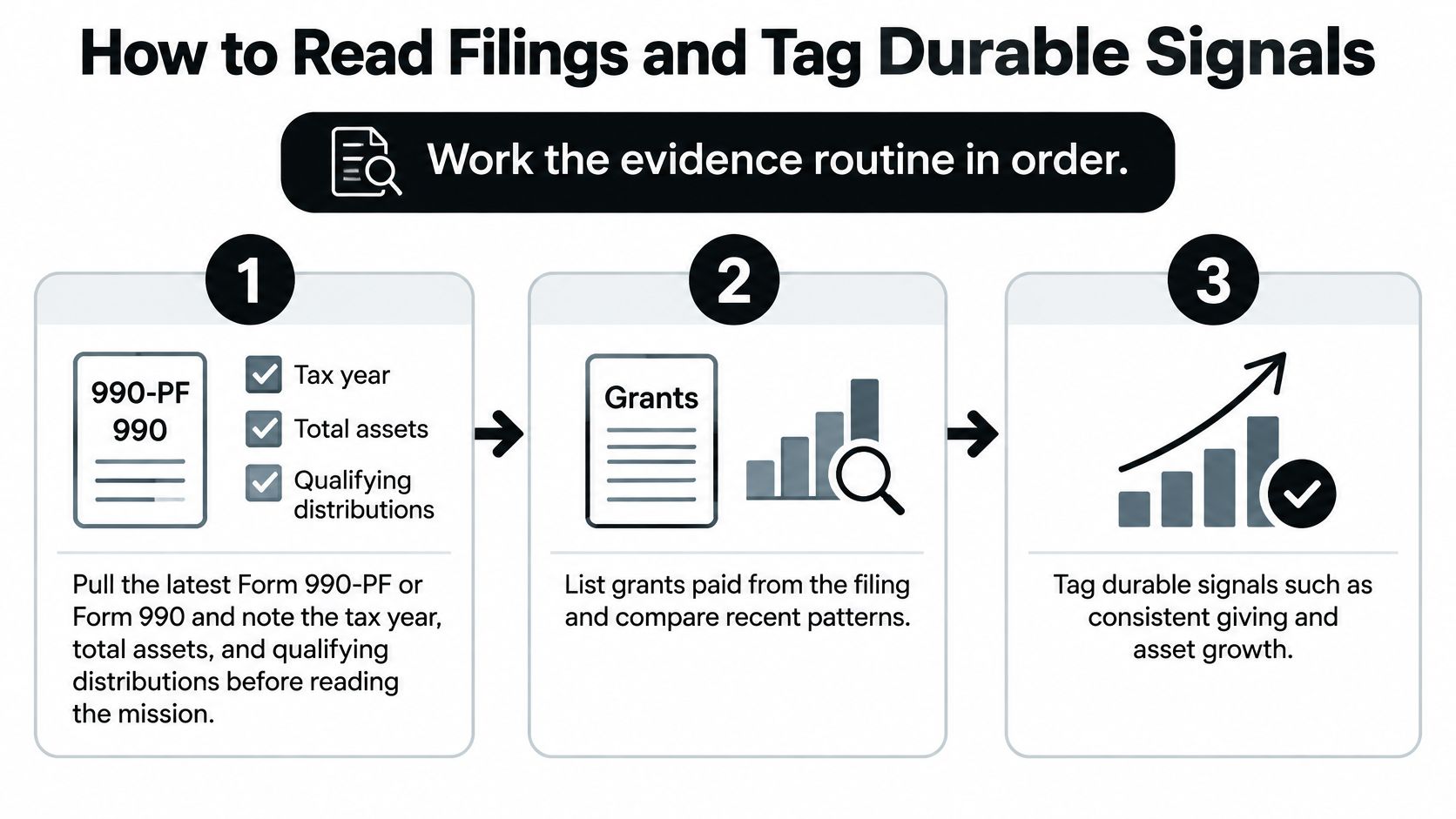
Use the visual routine as a starting point, then add the interpretation that a summary graphic can't supply.
Follow the evidence in order
- Identify the return. Pull the latest available Form 990-PF or Form 990. Record the tax period and total assets; for a private foundation, record qualifying distributions separately from grants paid.
- Extract grants paid. Capture recipient, amount, purpose, and available location information. Mark a recipient as new only when you've checked prior records or found explicit confirmation.
- Read the leadership list. Record officers, directors, and trustees for later relationship research. Section numbering can change across return versions, so follow the return's actual headings.
- Check current instructions. Read the foundation's guidelines for applicant restrictions, geography, deadlines, and unsolicited requests. Save the page and access date.
- Classify the signal. Compare purpose, flexibility, duration, and recipient continuity before treating an award as evidence of ongoing strategy.
- Stamp confidence. Note the filing year, source format, completeness of recipient information, unresolved contradictions, and next verification action.
Distinguish commitment from response
The Center for Effective Philanthropy's 2025 report found that 64% of foundations provided emergency or rapid-response grants in 2025, while 42% reported providing more unrestricted funding than before 2025. A topic match alone therefore doesn't establish a lasting funding priority.
Signal tags for recent grants
| Signal | What the filings show | Scoring effect |
|---|---|---|
| Durable strategy | Repeated field-specific grants, potentially unrestricted or multiyear, with new and repeat recipients | Strong when sustained evidence is verified |
| Policy shift | Recent consecutive filings moving toward the field, with changed purpose or flexibility | Provisional; verify current guidelines and announcements |
| One-time response | Awards confined to a restricted emergency pool in a single period | Weak evidence of stable fit |
| Unknown | Missing grantee names, stale records, or incomplete filing | Low confidence, never an automatic no |
These tags are interpretations, not facts printed on the return. Add the reason behind each classification, and tag every strongly scored prospect before outreach planning.
For a complementary filing walkthrough, use the video alongside the actual return you're reviewing.
Treat missing evidence honestly
A 2024 comment document submitted through the federal regulatory process reported missing fiscal-year-2021 grantee information in IRS XML files for at least 1,957 foundations representing more than $5 billion in grants. An empty extracted grants list isn't reliable proof of inactivity.
Missing data tells you what you can't conclude. It doesn't tell you the foundation won't fund your work.
Compare the XML, PDF, and foundation website. Use the filing for historical financial facts and current official guidelines for present application rules; a newer announcement doesn't rewrite an older return. If sources conflict, preserve the discrepancy and lower confidence rather than removing the prospect unnoticed.
Tools and Workflows That Scale the Routine
Choose tools by their job. A colleague should be able to inherit the process without reconstructing a researcher's browser history or learning an elaborate personal filing system.
Give each tool a defined role
- Evidence store: Use a shared spreadsheet with a stable identifier for each funder. Include scorecard fields, evidence references, filing year, confidence, and signal tag.
- Filing sources: Use IRS Tax Exempt Organization Search and available IRS extracts to locate returns. Compare structured records with PDFs and the foundation's own announcements.
- Discovery directory: Use a foundation directory or grant database to find candidates. Confirm eligibility against current official guidelines and grant history against the filing.
- Action tracker: Maintain an owner, next action, due date, and stop reason. A research note without an assigned action shouldn't appear as active proposal work.
- Refresh queue: Flag records for review when new returns appear, guidelines change, or a submission date approaches.
When comparing donor research tools, test whether staff can inspect the evidence behind a recommendation. Search speed matters less if the team must redo every eligibility check.
Automate after the manual pass
Review the active portfolio weekly and revisit signal classifications quarterly as a working cadence. Check new filings when they become available rather than assuming a calendar reminder makes old information current.
Software should handle repeatable exclusions, reminders, and record updates. Staff should resolve ambiguous geography, exceptional awards, and contradictory application instructions.
Handoff test: Another researcher should be able to explain why a prospect is active without asking its original owner.
Keep deferred records outside the writing queue, with a verification task attached. That preserves potentially useful prospects without allowing unresolved records to consume proposal capacity.
Keep a Portfolio of 10 to 20 Prospects
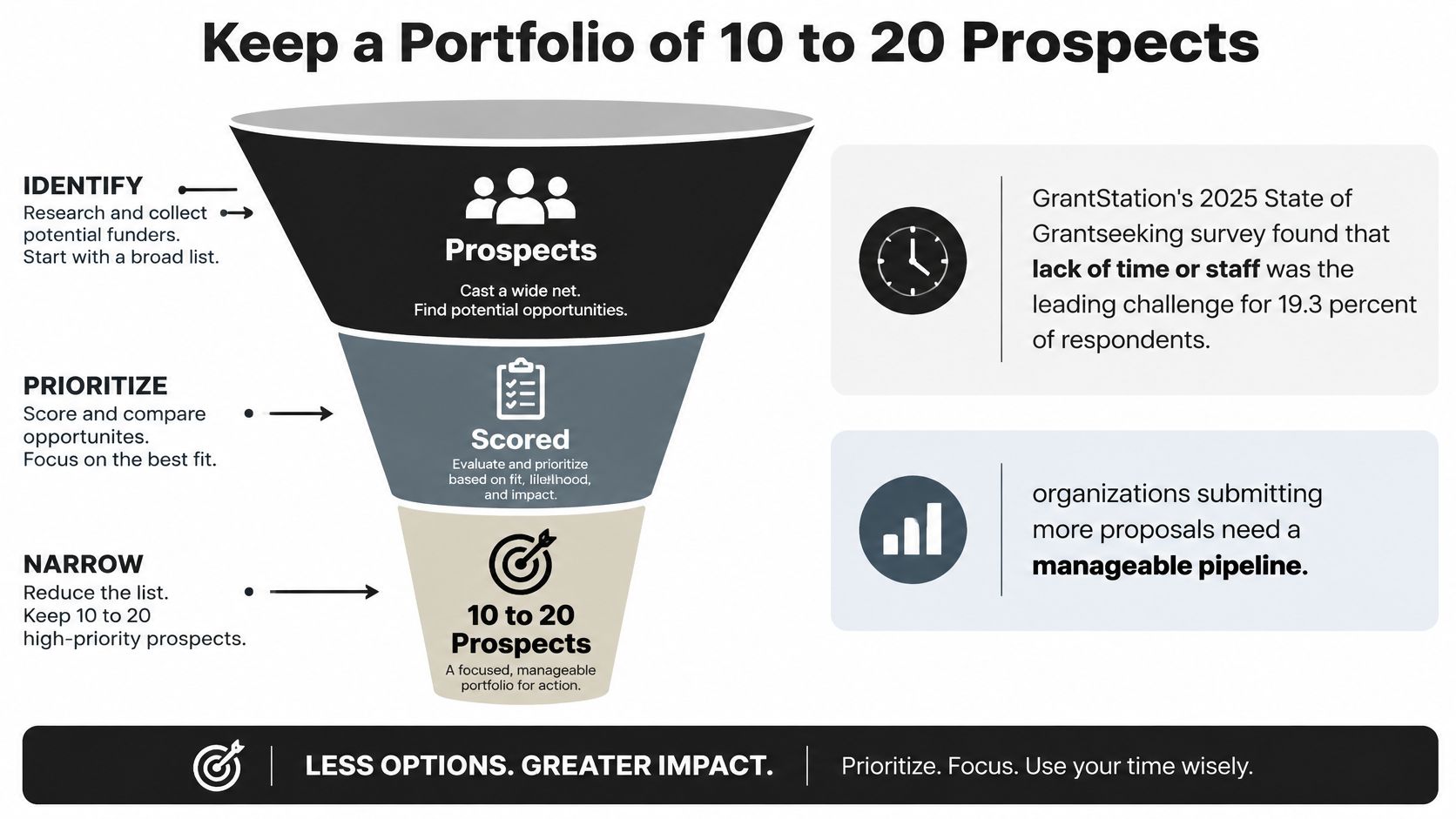
Staff capacity belongs in the prospecting decision. GrantStation's 2025 State of Grantseeking report found that lack of time or staff was the leading challenge for 19.3% of respondents.
Use a rolling portfolio of 10 to 20 thoroughly researched prospects as an operating limit, not a sector-wide performance standard. The right number within that range depends on how much research, relationship work, and writing your team can complete.
The funnel should narrow toward work your staff can finish.
Rank for action, not appearance
A complete portfolio record needs the fit score, filing year, recent grantees, award average and range, service geography, solicitation status, deadline, relationship path, confidence, signal classification, and next action. Store the award sample definition too, so a colleague knows which grants went into the average.
Apply these ranking moves in order:
- Remove failed gates. Put confirmed mismatches in a stopped view with a reason. Don't keep them active because someone recognizes the foundation.
- Sort qualified prospects. Rank by fit, then consider deadlines and the actual time needed to prepare. An approaching deadline doesn't rescue weak alignment.
- Replace completed or inactive work. Open substantial new research when an active prospect is funded, declined, paused, or moved out of the cycle.
- Refresh before drafting. Check for a newer return or changed guidelines before assigning a proposal.
- Allocate writing deliberately. Reserve proposal hours for prospects with adequate confidence, a usable submission route, and a realistic preparation window.
Protect room for judgement
A deadline-heavy list can still be an unworkable portfolio. If every prospect needs a complex budget, partner commitment, and executive review at the same time, reduce the active writing load rather than pretending the score resolves scheduling.
Distinguish discovery, qualification, cultivation, and application work. A trustee introduction can remain active without requiring a proposal assignment; a deferred data check shouldn't count as a ready application.
- For the researcher: Finish evidence checks before handing off a record.
- For the development lead: Match assignments to available writing and review capacity.
- For the executive director: Own introductions and decisions that require organizational authority.
If the list grows beyond your cap, move surplus names into a discovery backlog. They aren't lost; they haven't earned active staff time.
Treat scores as decision support, not proof of funder intent. Historical giving helps you choose where to work, but it can't disclose every internal commitment or predict the next award.
How to Sequence Outreach After the Score
Don't open with a full proposal unless the foundation explicitly requests one through its published process. First establish the appropriate route, the responsible staff member, and the question the contact needs to answer.
A warm introduction is useful, but it isn't permission to bypass application rules. Likewise, a foundation that accepts unsolicited proposals may prefer its portal over an exploratory email.
Follow the published route
Outreach sequence after a prospect clears the gates
| Stage | Who acts | When | Channel | Stop if |
|---|---|---|---|---|
| Confirm the gates | Researcher | Before contact | Internal scorecard | Any hard gate fails |
| Find a warm path | Executive director or board | First outreach week | Shared trustee or partner | No mutual contact exists; end the introduction search |
| Send a short inquiry | Grant writer | Early in outreach, if guidelines permit | Email or web form | Invitation-only rules prohibit contact |
| Send the LOI or concept | Grant writer | After a positive reply, or immediately if LOI is the published first step | Funder template | Funder declines or has no open process |
| Write the full proposal | Program lead and writer | When invited or unsolicited proposals are explicitly accepted | Portal or stated format | Deadline is missed or fit changes |
| Follow up once | Same contact owner | At a predefined internal interval, respecting funder instructions | Same channel | No reply after the follow-up; pause the prospect |
No mutual contact ends the warm-path search, not necessarily the application route. If unsolicited contact is allowed, proceed through that route without manufacturing a relationship.
For a short inquiry, identify your organization, describe the work, mention a comparable recent grantee, state the proposed request, ask a specific fit question, and offer a brief concept. Don't imply that funding a peer creates an obligation to fund you.
Apply the sequence to real decisions
In the hypothetical Colorado youth-arts example, a board member recognizes a foundation trustee through a community partner. The executive director asks the partner whether an introduction would be appropriate, then sends a compact program description after permission is confirmed.
If the program contact suggests an LOI, the writer uses the foundation's template and relevant letter of inquiry examples to prepare a focused concept. Program staff confirm activities and budget before the writer expands anything into a full narrative.
Contrast that with an otherwise attractive foundation whose guidelines say invitation only. If no relationship or invitation exists, stop the outreach assignment rather than emailing trustees individually.
- Record the permission: Save the invitation, published instruction, or program contact's response.
- Record the outcome: Distinguish declined fit, no response, and not yet eligible.
- Respect silence: Use a single planned follow-up, then pause rather than creating an indefinite chasing task.
For funders accepting requests without a deadline, contact them first when their instructions allow it. Confirm timing before committing staff to a narrative, but don't add an unnecessary contact step when the foundation explicitly directs applicants straight to an LOI.
Finish Ten Scored Records This Week
Use a simple Friday test: can a colleague open the sheet and act on ten finished records? A finished record has a decision, evidence, an owner, a next action, and a date. A list of famous foundations doesn't meet that test.
Start with funders who already know your organization and prospects identified through comparable organizations' recent grants. Split the initial batch between those sources so the team considers both existing relationships and unfamiliar possibilities.
Make the first pass manual
Assign the batch to named researchers and agree on what counts as complete before they start. Review a sample together to catch inconsistent scoring, unsupported assumptions about new grantees, and requests built around exceptional awards.
- Resolve actionable gaps: Verify a service-area restriction or application route before polishing the record.
- Park unresolved evidence: Give uncertain prospects a specific verification task instead of an invented conclusion.
- Approve the next move: Decide whether the owner should contact, prepare an LOI, monitor, or stop.
Only then hand repetitive national discovery to software. Otherwise, the team risks automating a scoring system it hasn't tested.
Grantlas supports that handoff by building an organization profile from a website or EIN and matching it with prospective funders. Our giving histories show typical grant size, giving cadence, and whether a funder has supported someone new; board and trustee listings help identify possible introductions. Red flags identify invitation-only restrictions, wrong geography, out-of-range grant size, and applicant ineligibility before proposal work begins.
Keep the standard concrete: by the next staff meeting, every active record should tell its owner what to do next. Research is underway when someone can make a defensible decision from the record, not when the spreadsheet becomes longer.
Visit Grantlas to build your organization's profile and evaluate a scored shortlist with plain-English fit explanations. Use its giving histories, trustee listings, and eligibility flags to turn your manually tested research process into a manageable outreach queue.